
May 16, 2026 - 01:00
Clazzy Shares Real-World AI Insights with UiTM to Bridge Academia and Industry

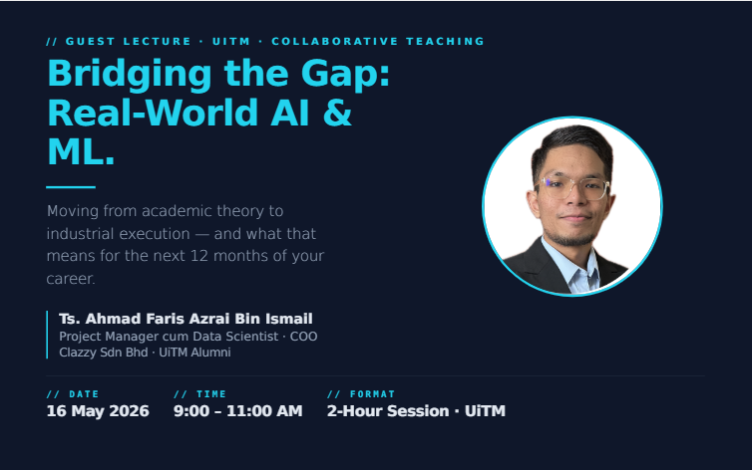
Clazzy Shares Real-World AI Insights with UiTM to Bridge Academia and Industry
Building meaningful AI solutions takes more than a strong model. It requires understanding real business problems, working with imperfect data, and delivering systems that people can use with confidence.
This was the central message of Clazzy Sdn Bhd’s UiTM guest lecture, “Bridging the Gap: Real-World AI & ML,” dated 16 May 2026. The lecture was presented by Ts. Ahmad Faris Azrai Bin Ismail, Clazzy’s Chief Operating Officer, Project Manager cum Data Scientist, and a UiTM alumnus.
Drawing on his professional journey and Clazzy’s project experience, the lecture connected academic foundations with the practical demands of AI development and delivery.
From Academic Theory to Industrial Execution
University provides essential foundations in programming, statistics, and machine learning. Applying those skills in industry introduces a wider set of responsibilities.
Real projects involve legacy systems, incomplete information, operational constraints, and stakeholders with different priorities. Model accuracy matters, but so do response time, cost, reliability, and the ability to maintain a solution after deployment.
The lecture explored the full industrial AI lifecycle: framing the problem, preparing data, developing models, deploying solutions, monitoring performance, and incorporating user feedback.
For students preparing to enter the workforce, the message was clear: understanding how a complete system works is just as valuable as understanding the model within it.
Bringing AI to Life Through Industry Experience
A central case study in the lecture was TNB TEASERS, presented as an AI assistant for field technicians navigating technical procedures, manuals, and troubleshooting information.
The case study examined a practical challenge: how can teams access relevant guidance quickly when the information they need is spread across extensive documentation?
The lecture introduced Retrieval-Augmented Generation (RAG) as an approach that connects an AI language model with a defined knowledge base. The system retrieves relevant material, uses it to prepare a response, and provides sources that users can check.
This example connected AI concepts with an operational need: helping people find and assess useful information in the context of their work.
Three Lessons for Building Better AI Systems
The lecture highlighted three practical lessons from developing AI assistants:
- Good answers begin with good source material. Clear, complete, and consistent documentation provides a stronger foundation for useful responses.
- Real users ask imperfect questions. Short phrases, mixed languages, and missing context need to be considered when designing and testing a system.
- Uncertainty must be handled honestly. An assistant should be able to say it does not have enough information and guide the user towards verification or further support.
These lessons reflect Clazzy’s focus on practical AI: solutions shaped by real working conditions and improved through testing, feedback, and continued refinement.
Responsible AI as Part of Project Delivery
The lecture also placed trust and accountability alongside technical capability.
Its discussion of responsible AI covered transparency, fairness, safety, human oversight, and privacy. Students were introduced to governance and assurance topics, including ISO/IEC 42001, SOC 2, and Malaysia’s personal data protection framework.
The wider message was that responsible delivery requires attention to how a system behaves, how its outputs can be checked, and who remains accountable for its use.
For future AI professionals, these considerations form part of building solutions that organizations and users can trust.
Helping Students Prepare for Industry
Beyond the technical content, the lecture offered practical steps students could take to strengthen their readiness for professional work.
These included building a small public project, learning collaborative development practices, gaining experience with deployment, and documenting both successes and failures.
The session material also explored different career paths, from data science and machine learning engineering to AI product management and technology risk.
Rather than treating AI as a single career track, it encouraged students to identify an area to explore and develop evidence of what they could build, explain, and improve.
Looking Ahead: Connecting Knowledge with Practice
For Clazzy, sharing industry experience creates an opportunity to make the realities of AI delivery more accessible to emerging talent.
The UiTM lecture brought together technical foundations, project lessons, and career guidance around one central idea: valuable AI begins with a clear problem and succeeds through thoughtful execution.
As students develop their skills, the ability to connect technology with human needs, operational requirements, and responsible practices will help them contribute to meaningful projects.
Interested in an industry sharing session, an AI workshop, or an academic collaboration? Contact Clazzy Sdn Bhd to explore how we can bring practical AI experience to your institution or team.